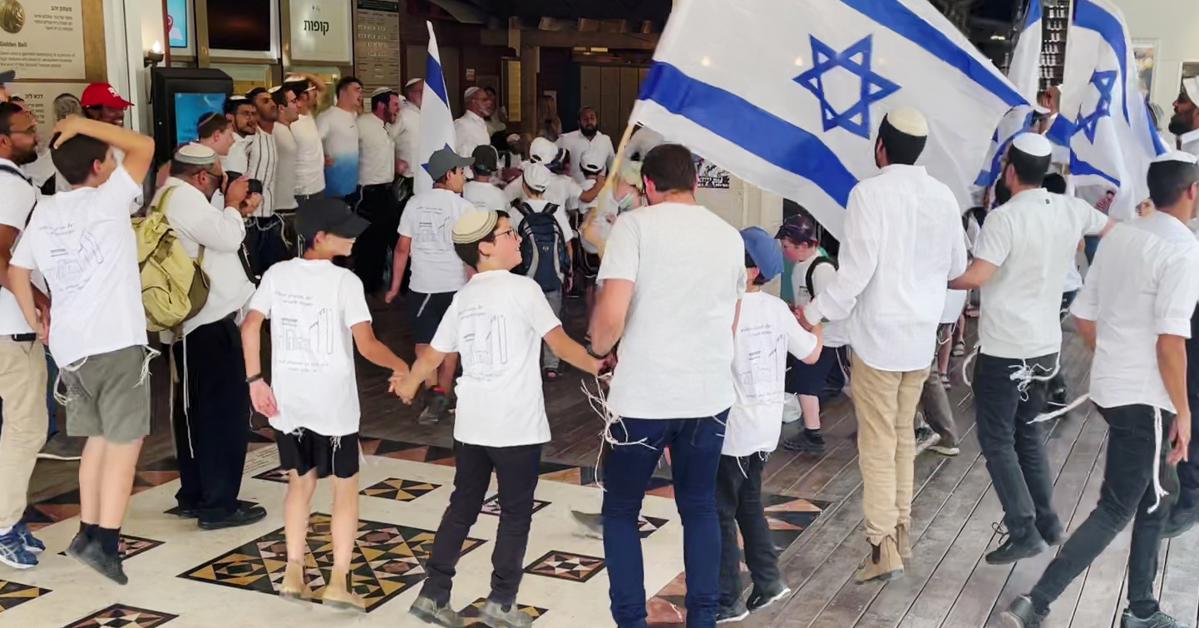
This year Israel celebrated 55 years since the liberation and reunification of Jerusalem brought about by the Six Day War of June 1967. We were blessed with the opportunity to be in Israel on Jerusalem Day to witness this firsthand. Anyone following developments in the media could be excused for assuming that the war was still being fought 55 years later!
The Liberation of Jerusalem
The backstory to Jerusalem Day is the dramatic events of 1967. It has been noted that even when Israel lived inside its pre-1967 borders, the stated goal of the “two state solution,” it was still unacceptable to Israel’s Arab neighbours.
A contemporary report1 recalls that the crisis began with Egypt’s demand on May 17th for the withdrawal of the UN forces from the Egypt-Israel border. The Secretary-General conceded, and encouraged by this, on May 22nd Egypt closed the Straits of Tiran to Israeli ships. At the smell of conflict with Israel, the Arabs immediately rallied around President Nasser. King Hussein of Jordan, whom Nasser had been insulting as a traitor to the Arab cause, flew to Cairo to sign a pact and embrace his enemy, side by side with the leader of the Palestine Liberation Organization who had been attempting to topple the King (the PLO was finally expelled from Jordan in 1971). Saudi Arabia and Iraq supplied troops. Israel, who believed its survival was at stake, was outnumbered by more than two to one.
Sixty hours after the first shot the whole balance of power in the Middle East had changed. Fighting broke out on June 5th and a resolution calling for a “cease fire” was unanimously adopted by the U.N. on June 6th. Jordan complied, but Egypt and Syria rejected the resolution. Israel announced readiness to observe a cease fire provided the Arab States did the same. On June 8th Egypt, after retreating over the Suez Canal, agreed to the cease fire, followed by Syria early on June 9th. Israel made sure of taking the Syrian Golan hills from which they had suffered constant raids and bombardment.
The Jewish Observer on June 9th commented:
“Seven days ago we wrote that the Jewish people cannot rely on miracles. But what has happened since then cannot be comprehended in any other terms.”
Christadelphians saw the work of the Divine hand in these events as the words of Luke 21:24 became so much closer to their ultimate fulfillment:
“This people shall fall by the edge of the sword, and shall be led away captive into all nations: and Jerusalem shall be trodden down of the Gentiles, until the times of the Gentiles be fulfilled.”
This stirred up great excitement resulting in special lectures being arranged around the world, many at short notice. In Bournemouth a lecture was arranged before the Six Day War had even ended:
‘With the co-operation of local ecclesias, the opportunity brought by the thrilling happenings in the Middle East was effectively taken to bear witness to the Faith. On June 8 the Bournemouth Town Hall was used for an address upon the subject: “Middle East Crisis! Israel’s Destiny: God’s Answer.” A full-page advertisement had been inserted in the local press and the response was gratifying. Bro. W. Gillingham spoke to an audience of about 800, of whom at least 300 were interested friends, and most of them readily sought the literature that was made available afterwards’ (The Christadelphian, August 1967).
This provided the opportunity for congregations to come together to witness to the public on the hope of Israel as reported from Australia:
“Ten Melbourne ecclesias co-ordinated their lecture titles for Sunday, June 18, and spent $500 on advertising in the Daily Press. Over 100 visitors attended to hear talks on ‘God’s Purpose with Israel.’ Requests for literature from this and other newspaper advertising in the past month have numbered over 300. Plans are now in hand to hold a series of Home Discussion Classes in different parts of Melbourne on the general theme: ‘Are we living in the last days?’ ” (The Christadelphian, August 1967).
Similarly in the UK,
‘The news from the Middle East stirred brethren and sisters everywhere, and with it came the urge to tell our hope to the world in the light of current events. In many parts of the country lectures were arranged on the relation of Israel and the Middle East to the prophetic hope and the Gospel of salvation.
Birmingham (Central) ecclesia, with the active support and co-operation of fifty ecclesias in the surrounding area, arranged a lecture in Birmingham Town Hall on ‘The Bible and the Middle East: God’s purpose in the Holy Land.’
…Two thousand people filled all available space in the Town Hall, and some three hundred more listened to a relay in the basement. It is believed that about three hundred were visitors drawn by the publicity or brought as friends” (The Christadelphian, July 1967).
They Shall Return, and Come with Singing unto Zion
In May this year, at the time of our visit, Israel was gearing up to celebrate the miracle of 1967 and the liberation of the Old City of Jerusalem, the Golan, and much of Judea and Samaria. In Jerusalem the feeling of excitement hung in the air. On Saturday May 28th, at the end of the Sabbath, we decided to take an evening walk down from our apartment to the Western Wall. Earlier in the day, as we wound our way along the quiet streets, which were now starting to come back to life, we had heard the joyful sounds of singing and dancing coming from a Yeshiva (Jewish religious school). Now, as we entered through the Old City through the Jaffa Gate, we found that the Jerusalem Day celebrations were already beginning (the day set by the Jewish lunar calendar). The streets and alleyways were filled with families, children, grandparents, and curious tourists, many carrying Israeli flags. As we neared the Cardo in the Jewish Quarter, we again heard the sounds of singing. Hundreds of people crowded around to watch the young men, fathers and grandfathers singing and dancing.
This was not an isolated incident. Enthusiastic singing and dancing was happening spontaneously almost everywhere we went in Jerusalem, both that night and the following day. At the Western Wall plaza, pounding the floor outside the visitor center at the City of David, and throughout the march all along Jaffa Street (where we later enjoyed our evening meal watching the marchers still passing by). The Biblical themed songs included, “If I forget thee, O Jerusalem” (Psa. 137); Jerusalem of Gold; Am Yisrael Chai (The People of Israel Live, c/p Ezek. 37); “To Jerusalem your city you shall return with mercy… And re-build it soon in our days;” “Elijah the Prophet… May he soon come to us, with Moshiach (Messiah) the son of David.” Men marched into the Old City through the Damascus Gate and women through the Jaffa Gate singing what we might rightly call the “songs of Zion.” This is what the leftist media call racism. We witnessed no violence and were never uncomfortable despite a larger than usual security presence. The celebratory atmosphere was shared by people of all ages, ethnicities, and walks of life, religious and secular.
Jerusalem Day seemed to have a similar spirit to that of 1967. A “moving account” in the June 30, 1967 issue of the Israel Digest could have been describing what we witnessed 55 years later:
“Throughout the hours of daylight on June 14, Jews from every part of Israel thronged through the Dung Gate of the Old City, to celebrate the Festival Shavuot at the foot of the Western Wall. Shavuot, the Jewish Feast of Weeks, celebrates the bestowal of the Torah on Mount Sinai and the picking of the first ripe fruits. For the first time since the Dispersion in the year 70 C.E. a pilgrimage numbering two hundred thousand persons moved under the Flag of Israel through the streets of King David’s City to the last surviving relic of the Second Temple. Every section of the population was represented, kibbutz members and soldiers in tallitot (prayer shawls) rubbing shoulders with ultra-orthodox rabbis. Mothers came with children in prams, and old men trudged steeply up Mount Zion, supported by youngsters on either side, to see the Wall of the Temple before the end of their days.”
“Some wept, but most faces were wreathed in smiles,” continues the report, with a striking recollection of the scene described in Ezra 3:12-13 when many ‘wept with a loud voice, and many shouted aloud for joy’ at the laying of the foundation of the Second Temple” (The Christadelphian, August 1967).
The Controversy of Zion
We did not see what we observed represented in mainstream media at all. The media reports were focused on an agenda, amplifying isolated incidents and opposition to Jerusalem Day (similar to the one Nazi flag that was found to photograph in Ottawa, Canada in early 2022). On May 30th, CNN reported “Tensions boil over as Jewish nationalists march through Palestinian district of Jerusalem’s Old City.” This is a good example of the misleading headlines that were being pumped out leading up to and on Jerusalem Day. Now, the so-called Muslim Quarter (which had a Jewish majority until the 1929 Arab riots) is being called the “Palestinian district”? Every attempt was made to suggest that a march of Jews in their own capital, which when it did happen was peaceful, would actually be responsible for violence (which was threatened by the terrorist group Hamas). The march was labeled as “racist,” “far right,” and “extremist” by many news organizations (see Bible in the News, June 6, 2022), some of whom seem to have backtracked and scrubbed the articles from their archives.2
Israeli society is deeply divided between the secular postmodernist left and the Biblical religious right, similar to Canada, the United States and other countries. Despite being separated by less than 70 km, a great ideological gulf exists between Tel Aviv and Jerusalem. However, other external forces are also at work, happy to exploit the situation agitating from the remote safety of Rome, and other European capitals. The Vatican has long campaigned for Jerusalem to be an international city, and did so in 1967 as we see from an editorial in the Vatican magazine, L’Osservatore Della Domenica:
“The Church demands that an international authority, founded on the principles of the United Nations and the declaration of the rights of man, take over the city.”
The Palestinian Arabs have been a convenient tool to support this agenda. Neither they nor the Vatican accept the authority of the Bible. A Christian is forbidden by the Muslim authorities to take a Bible onto the Temple Mount. The Roman Church burnt and banned it in the Dark Ages. As in 1967, animosity and differences are put aside when Israel is the common enemy. It will be this ideological war, against Israel and the Bible, that will bring about the controversy of Zion revealed in the Hebrew prophets.
The Young Generation Connected to the Land
Even the religious segment of Israeli society is fragmented. Those in the nationalist camp see 1967 as a miraculous victory. We spoke with Lenny Goldburg about this, a resident of the settlement Kfar Tapuach. He noted the connection between the Torah (Old Testament) and living in Eretz Israel, the land of Israel. I asked him, as well as a few others, if he thought Israel was becoming more or less religious. Generally it was thought that Israel was becoming more religious, but Lenny observed that it was very polarized, with some becoming very religious and others more leftist, against religion. Of those becoming religious some stress the social and family aspects of Judaism, but not the Messiah, the wars, the nationalist aspects. Lenny noted that:
“They still have an exilic approach. After being in exile for 2,000 years Torah learning hasn’t adapted itself to the Jews having a real land, the Western Wall of the temple, and real enemies like in the Bible! There are traditions for eating kosher, for cooking chicken, that still apply, but not for these aspects of national life. Now the Torah has an application on a national level, not only on a private level. When it comes to a temple, to Jews back in the land, whoa, that’s new stuff! They have not adapted to it. To simplify it, a lot of the black hat Haredi camp (Ultra Orthodox), say it is politics. The land, the wars, that’s for the secular Jews. They don’t realize that’s part and parcel of what’s in the Bible.”
We saw this difference in the makeup of those celebrating Jerusalem Day. Lenny continued,
“That’s important. We won the Six Day War, an unbelievable miracle… I’m glad the young generation appreciate it, that all those years we were under Jordan and the Kotel (Western Wall) was cut off and divided and now we take it for granted. When I see those kids out there, I see they know their history, they are not taking it for granted. They realize what a beautiful miracle that was. We had the famous ‘the temple mount is in our hands’ but we gave it back because the leaders like Moshe Dayan were such secular non-believers.”
Similar to the days of Joshua, it may be the younger generation who will welcome the Messiah when he comes. Today the Jews do not know who he is, but that will soon change!
“Rejoice greatly, O daughter of Zion, Shout, O daughter of Jerusalem; Behold, thy king cometh unto thee, He is triumphant, and victorious… And he shall speak peace unto the nations; And his dominion shall be from sea to sea, And from the River to the ends of the earth” Zech. 9:9-10 (JPS).
Endnotes:
1. The Christadelphian, July 1967, p.323.
2. c/p The Israel Guys, June 2 YouTube podcast, https://youtube/9HMofR79x2k