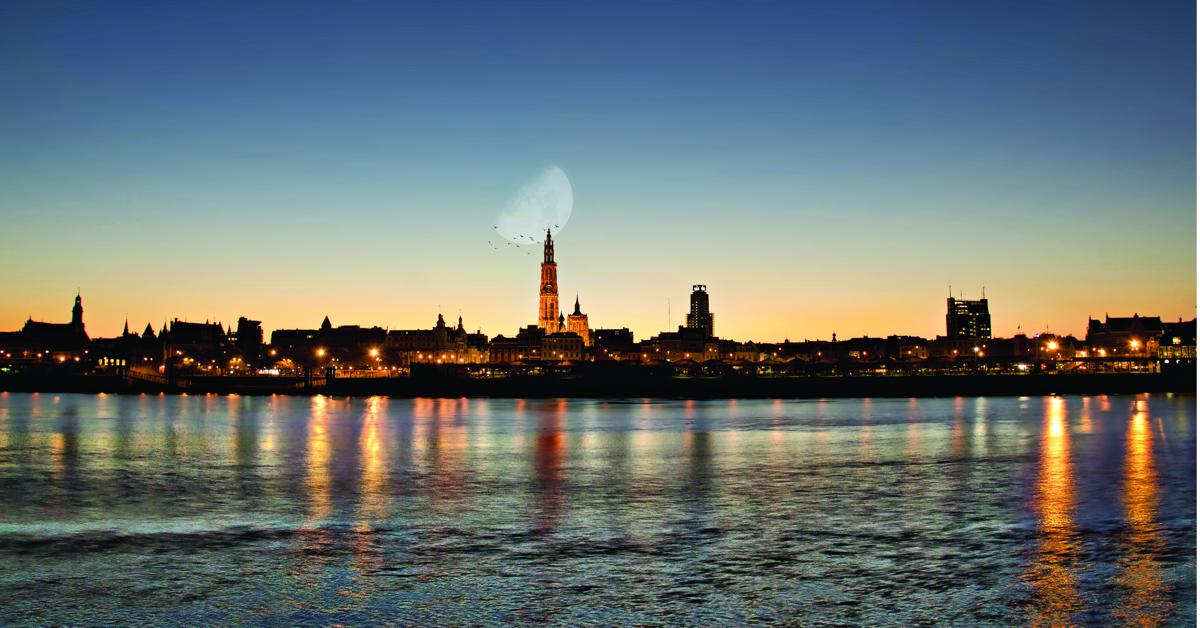
Five hundred years later, it is hard for us to truly understand how revolutionary it was to make the Holy Scriptures available to the common man. It was the dark ages. Echoing the words of Isaiah 60:2, darkness covered the earth, and gross darkness the people. It was an age almost entirely in darkness as to what the law, the prophets, the apostles, and even Christ himself actually said.
It is equally hard to truly understand how much power the Roman Catholic Church had over the peoples of Europe and England. Your place in this life, and even after this life, was in their hands. Excommunication now, and a future eternal damnation in hell, was theirs to dispense. With this kind of authority over the people, even kings trembled at their word. The Roman Church was the most powerful force in the Western world, with little competition.
The competition would come as the common man began to hear—and, in time, read for himself—the light of Scripture, as the dawn of the Reformation began. In Wide as the Waters, Benson Bobrick writes:
“In short, the English Bible, with all that followed in its train, had sanctioned the right and capacity of the people to think for themselves.”
It was William Tyndale who made it his life’s mission to translate the Scriptures into English from the original Greek, not from Latin. In 1523, Tyndale crossed the London Bridge looking for permission and even assistance in the great work. This was a project that, at that moment was unimaginable, for the English crown or clergy to sanction, for it was the greatest threat to their power.
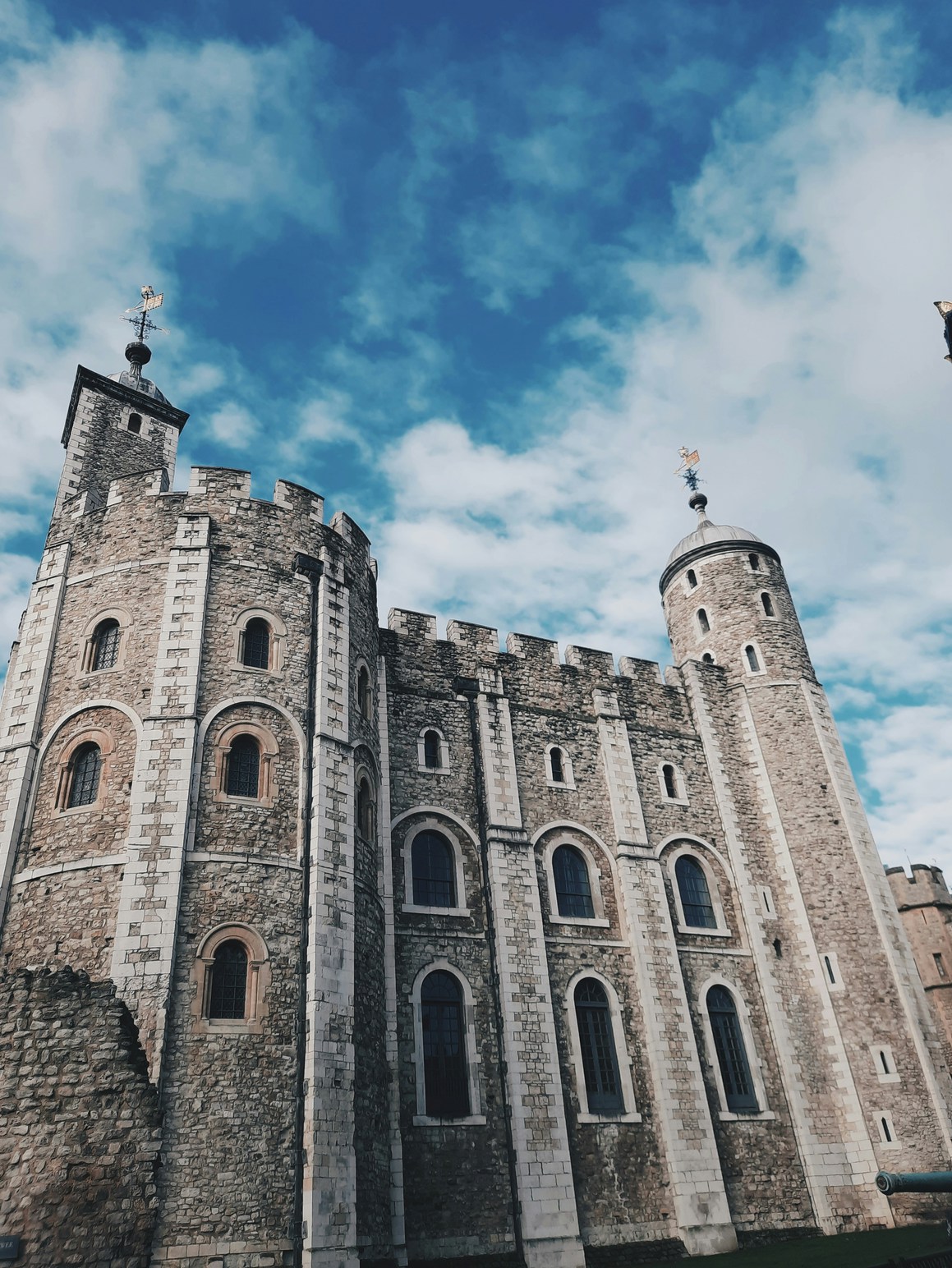
Not far from the London Bridge, the Tower of London ominously stands to this day. Tyndale would no doubt have known of the many Lollards, followers of John Wycliffe, who languished in its dungeons awaiting execution, even as he entered the city. It was John Wycliffe, who over a century before had produced handwritten copies of the English Scriptures, although not from the original text. His work was completed long before the printing press was invented. After his death, the first English statute was passed in Parliament in 1401 for the burning of heretics. Seven years later, in 1408, the Synod of Oxford outlawed unauthorized translations of the Bible into English and forbade even the reading of such unauthorized translations.
As for Wycliffe, he had died a peaceful death. However, for his noble enterprise of challenging the authority of the Church, he was posthumously declared a heretic in 1428. His bones were exhumed, burnt, and scattered in the River Swift. It would take 140 years after Wycliffe’s death before Tyndale would produce another English Bible. This time, the opposition would be immediate.
In London, Tyndale would not find approval for his English translation; however, he would meet and stay with an incredible character, Humphrey Monmouth. Humphrey was a well-connected merchant, a member of the Christian Brethren (an underground cell of fellow members of various Livery Companies who followed Luther’s teaching), and, most importantly, he was eager to assist in the great work. In short, Humphrey became a smuggler and dealer of this most precious contraband!
Tyndale alone could not have accomplished the mission, but together they changed the world.
Escape to Europe
In 1524, Tyndale was ejected from the Church for his “heretical” teaching and for beginning to translate the New Testament into English. He had told the Bishop of London, Cuthbert Tunstall, of his intention, who in turn brought it to the attention of Henry VIII.
Tyndale was now on the run, moving from town to town, and very little is known of his movements. In fact, for a man who changed the world, it is surprising we do not even know what he looked like! The National Portrait Gallery in London notes that, “There is no authentic portrait of Tyndale. By the early 17th century a false type was in circulation... This false portrait of Tyndale derives from a portrait of John Knox, sent from Scotland.”
With the King’s agents on his tail, what we know is that Tyndale wasted no time. He did manage to flee England, never to return, and headed to Germany, landing on the continent in Hamburg on May 27, 1524. From here, it is believed that he headed to Wittenberg and registered at the college under an alias. Brian Edwards writes the following in God’s Outlaw:
“In a copy of the registers of the University of Wittenberg a strange name appears under the date 27th May, 1524, Guillelmus Daltici ex Anglia— William Daltici from England. The date and circumstances fit exactly. The reformer to conceal his identity, reversed the two syllables of his name Dal-tin and a later copyist merely confused the n for ci.”
Although it is thought that he spent time with Martin Luther in Wittenberg, he did not stay long. He was determined not to be a “Lutheran.” Even though Luther called for the Roman Church to be reformed, he retained many of its doctrines, such as transubstantiation (the belief that the bread and wine become the actual body of Christ). Tyndale was fiercely independent and far more willing to challenge Rome.
The following year, in the spring of 1525, is Tyndale’s first known sighting in Cologne, a key independent trading city on the Rhine. Already, by that summer, pages of his New Testament were coming off the press, much to his delight! Although independent and with many reformers residing there, Cologne was still heavily Roman Catholic, and word soon got out. Tyndale again had to jump town with whatever sheets he could, this time at night, to avoid arrest. These incomplete quarto-sized copies were still valuable and were therefore smuggled into England, boosting interest and whetting the appetite!
For Tyndale, this close call confirmed how vulnerable he was, even outside of England, to those hunting reformers like himself. It was an incredibly hard life, and moving forward, he would take additional care to avoid detection.
Worms
Tyndale was again on the move. This time, he went further south to Worms, a town where only four years prior, Luther himself had been tried for heresy, and his works banned. The town was known to harbour many a Protestant rebel, the printer Peter Schoeffer the younger, the son of a former apprentice of Johannes Gutenberg, being among them. The rise of Protestantism was growing, and not long before Tyndale’s arrival, city officials had given their allegiance to Luther and the Reformation. This was enough for Tyndale, and by September, Schoeffer was beginning to produce crisp pages of this English New Testament.
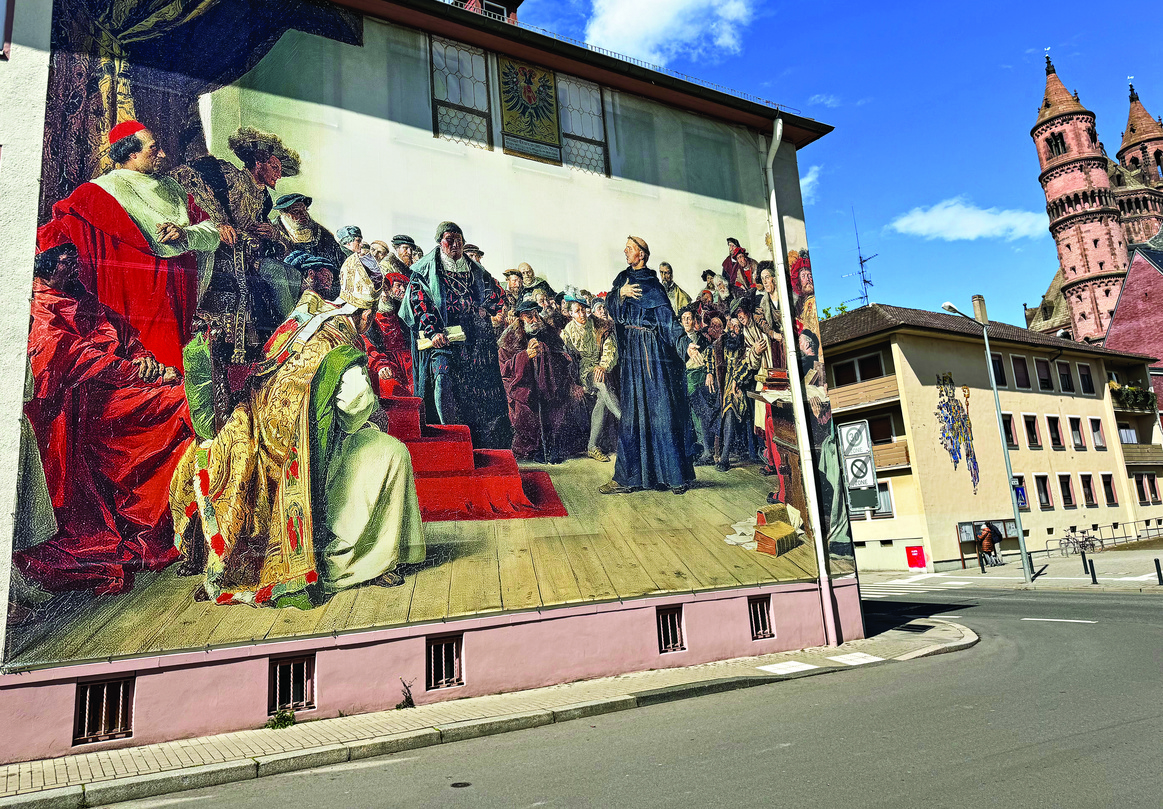
Last year, we had the opportunity, with our family, to trace many of Tyndale’s steps through England and Europe. Still, to this day, the Protestant history of Worms can be felt even though, as with almost all the historic towns of Europe, the presence of the Roman Catholic Cathedral dominates, both visually and audibly, with the frequent ringing of bells. Regardless, an enormous mural of Luther’s appearance at the Diet of Worms can be found near the Cathedral, where he famously refused to recant his writings. Also standing in the town is what Worms claims is the largest Protestant monument in the world. Of Tyndale, however, there is little reference, although the Worms City Library does house a replica of Tyndale’s New Testament.
With an estimated population of only 7000, and with Schoeffer being the only printer in Worms, keeping this monumental project hidden from Church authorities is amazing in and of itself. To complete the project as quickly as possible and to keep the Bibles as small as possible for smuggling, Tyndale cut out the extras. There are no prologues to the books, no marginal notes, no marginal references, and certainly no mention of William Tyndale himself. The Bibles were pocket-sized to aid their smuggling into England, and to aid any who dared carry a copy.
After a terrible harvest in the autumn of 1525, followed by a severe winter, Britain was experiencing famine. This backdrop was appropriate as Tyndale’s New Testaments began moving across the English Channel and arriving on the shore of the Thames in London, where Humphrey Monmouth was waiting!
Learning Hebrew
In these fugitive years of Tyndale’s life, it is not known when exactly he learned Hebrew, let alone mastered it, to enable the production of an outstanding translation of the English Old Testament. He may have had some introduction to the language in England; however, Jews had been banished since the reign of Edward I, and Hebrew was not taught at any of the Universities.
Almost all agree that Tyndale learned his Hebrew on the Continent during these years on the run. It is my personal belief that he would have learned much in Worms. It was a city with a Jewish community that had existed since at least the 11th century and was located only a short walk from Schoeffer’s print shop.
Interestingly, only two years later in Worms, the Anabaptists, Ludwig Hatzer and Hans Denck, published the first translation of the Old Testament Prophets from Hebrew into German, popularly titled the Worms Prophets. Martin Luther, a known antisemite, criticized the translation as being overly influenced by the Jews. This criticism is strange, for surely the rabbis would be the obvious experts on the Hebrew language!
No doubt Tyndale would have jumped at the opportunity while his New Testament sheets came off the press to stroll down the cobblestoned Judengasse, the Jewish Street, to meet the rabbis and discuss the translation of their precious Torah.
English New Testaments arriving
During much of Tyndale’s time on the Continent, although there are firm dates and locations for some of his activities, it must be admitted that many of his exact movements are not known or are contested. The danger to Tyndale would continue to grow as his New Testaments arrived on England’s shores in the spring of 1526, and as his criticism of the Roman Catholic Church increased.
Back in London, Bishop Tunstall determined to stamp out this “heretical Bible,” and would work with Augustine Packington in 1526 to purchase all he could, paying “what ever they cost,” that he might burn them. There was only one problem—Packington agreed with the cause of the Reformation himself! With this offer from Tunstall, Packington went to Tyndale, who agreed this would fund a larger and corrected second printing of the same New Testament. As John Foxe writes in his Acts and Monuments, “the Bishop had the books, Packington had the thanks, and Tyndale had the money.” After this, Foxe comments that the Bibles now “came over thick and three fold over into England!”
In the following years, the situation grew much more perilous for Tyndale. In Ant-werp, the printer Christopher van Endhoven was arrested for producing another edition of Tyndale’s New Testament. In London, Monmouth would be hauled in and questioned. In Oxford, Thomas Carter’s secret ring for distributing prohibited books had been smashed early in 1528, when four reformers died during their imprisonment in the fish cellars of Cardinal College. Tyndale’s dear friend John Frith would also be arrested and imprisoned in the fish cellar at Cardinal College, for condemning the Church’s belief in purgatory and transubstantiation. Frith was released six months later, making it out alive. Once out of that fish cellar, Frith wasted no time as he fled to the Continent, joining Tyndale in Marburg, Germany, where you could taste the freedom, and not the air!
Marburg
To avoid capture, Tyndale would again move and, in 1527, headed east, far inland to Marburg, a sleepy town 100 miles north of Frankfurt and deeply impacted by the Reformation. So much so that the same year that Tyndale arrived, the first Protestant University in the world was being founded.
Tyndale continued to write and translate, working with John Hoochstraton, a printer of Antwerp, who would print under a false identity. Some even believe he went so far as to relocate his printing press to Marburg. Regardless, the presses were busy. Beyond producing Bible leaves, Tyndale would publish The Parable of the Wicked Mammon and The Obedience of a Christian Man, which were increasingly hostile to the Roman Church.
The Reformation in England, which the cardinals and bishops had managed to keep a lid on, was like a simmering volcano that now was blowing its top, all because of the work of Tyndale.
Antwerp
In the 16th century, Antwerp was a large, affluent, bustling port, trading center, and cosmopolitan city, with a population of upwards of 100,000. Like Worms, it too was dominated by an enormous cathedral—the Cathedral of Our Lady. For Tyndale, most importantly, it was the greatest industrial centre of Western Europe, with between 40 and 60 printing shops operating at the time.
Today, one printing shop from 1580 remains in Antwerp, providing an incredible example of 16th-century printing—the Museum Plantin-Moretus, now a UNESCO Heritage Site. Although this printer, being Roman Catholic, would not have been caught printing the Bibles of the reformers, it is still a fabulous experience to wander through the narrow hallways and over the creaky floors of this historic enterprise, caught in time.
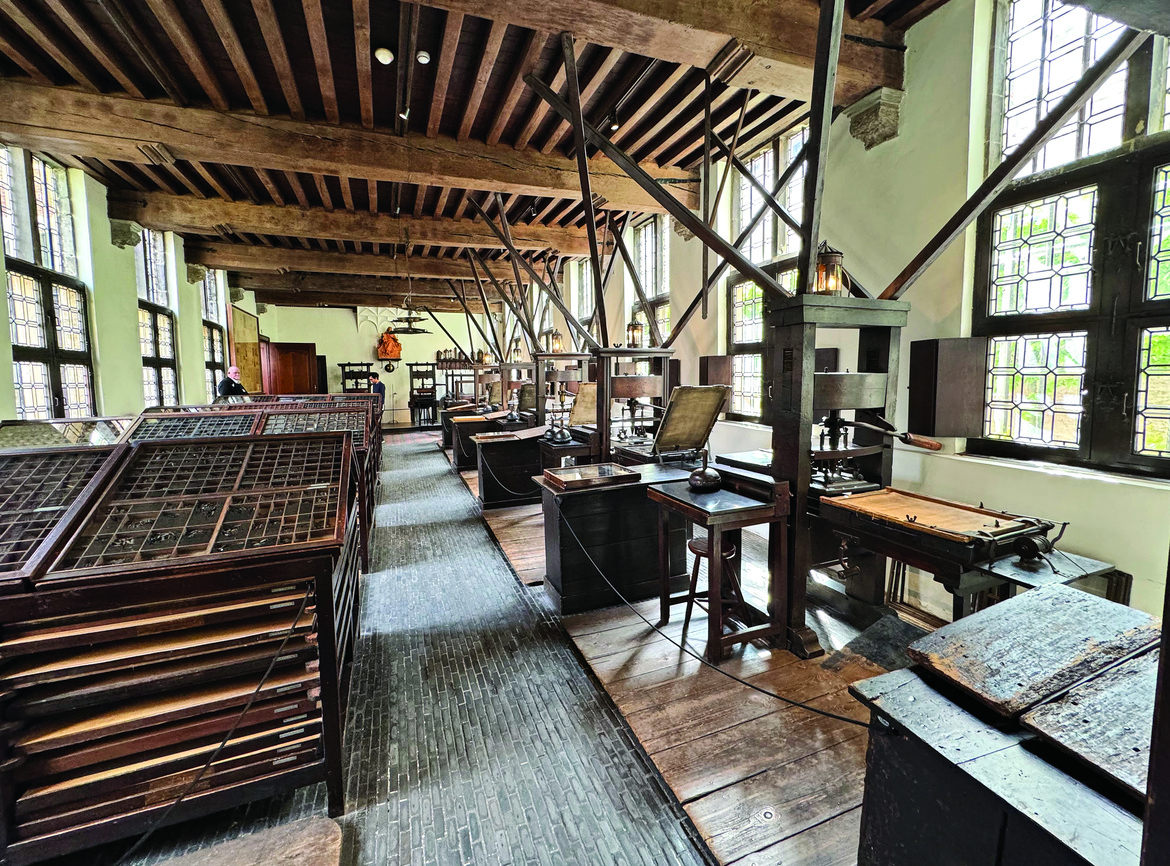
In the printing shop, there are five presses from the 17th or 18th centuries, and two from approximately 1600. These two are the oldest preserved printing presses in the world. According to the museum, “in the case of a ‘normal’ book, 1,250 sheets could be printed on both sides in a day on a single press. This required the printer to perform 2,500 impressions!” These were numbers Wycliffe could only dream of!

Tyndale’s books and Bibles were smuggled out of Antwerp in bales of cloth. Packaging was done in cellars in the town before they were moved to the port and loaded on Humphrey’s ships. You can visit old cellars in the area where these precious packages were made. It takes very little imagination to see the Bibles being quietly brought in and the cloth bales loaded out!
As perfect a location as Antwerp may have been, it was an obvious place when hunting for Tyndale. And, sure enough, in 1528, the house of Richard Harman, another supplier of Tyndale’s New Testaments, was searched. In January 1529, Tyndale was mentioned in court as being a heretic. And, in the summer of 1529, Bishop Tunstall himself visited the city looking for any clues leading to Tyndale.
It was clear that Tyndale could not linger in Antwerp, and so he decided to move on to Hamburg, still close enough to England for smuggling, but out of the limelight for printing his Pentateuch. With his Pentateuch manuscripts under his arm, Tyndale boarded a ship in Amsterdam destined for Hamburg. Tragically, disaster struck as the ship was wrecked crossing the infamous North Sea. Although his life was spared, his precious manuscripts were not.
In Hamburg, Miles Coverdale would work with Tyndale as the project was started afresh. Tyndale and Coverdale would commence work in March 1529 and work until a new manuscript was ready for the presses that December.
Shockingly, back in Antwerp, a new edict was passed in October of the same year declaring the following:
“That nobody should presume from that time forwards to write, print, or cause to be written or printed any new book upon what subject soever, without having first obtained letters of licence for the said purpose; on pain of being pilloried, and marked besides with a red-hot iron, or an eye put out, or a hand cut off according to the discretion of the justice, who is to see the sentence executed without delay or mercy.”
It was not enough to deter Tyndale or the renowned Bible printer, Merten de Keyser, whose print shop had just been relocated to Antwerp from Paris that same year. The Pentateuch was printed in Antwerp in 1530, complete with scathing marginal notes against the Pope. Tyndale’s life was not about to get any easier.
Henry Reaches Out
About the same time, King Henry VIII made contact with Tyndale, passing letters through a merchant, Steven Vaughan. Henry was inviting Tyndale back to England, and Tyndale was highly suspicious of the invitation. With Tyndale’s rejection of Henry’s advances, the anger would rise in the English court.
It is also about this time that Tyndale would engage in a battle of the pen with Thomas More, publishing The Practice of Prelates in Antwerp in 1530.
The truth of the matter was that the Reformation was spreading, and with printing presses across the Continent, it was an impossible force to stop. Just as Rome was unable to extinguish Christianity in the first century, it was powerless again here. For all those it burned at the stake, it only fuelled the desire for change, proving itself far from the true bride of Christ.
One of those who was burnt at the stake, this time alive, was the dear friend of Tyndale, John Frith, in 1533. He had returned to England, against Tyndale’s advice, and been captured.
As difficult an environment as this would have been, Tyndale was still working on his revised New Testament, which would be published in 1534 and become the foundation for the Thomas Mathews Bible that would come out shortly after Tyndale’s death.
1534 was the same year that Tyndale was invited to live with Thomas Poyntz in the English House in Antwerp, but the authorities were on his trail. Sadly, it is here that Henry Phillips gaining Tyndale’s confidence and betrayed him in the narrow alleys of Antwerp. Tyndale was aware that this time was likely to come. In his decade of exile, he had put his hand to the plough and never turned back. How thankful we can be that he did. The work would be for others to complete.
Tyndale was taken south to Vilvoorde Castle. They were miserable days in the cold damp cell, and Tyndale’s only letter to survive is from this time. It is a heart wrenching letter as he requests warmer clothes, a candle “for it is wearisome to sit alone in the dark”, but “above all” Tyndale requested his manuscripts to enable him to continue translation. What an example of dedication.
Tyndale was transported out of the castle toward a stake that awaited him. He was strangled and burnt at the stake in October 1536, before which he famously prayed aloud, “Lord, Open the King of England’s eyes.”
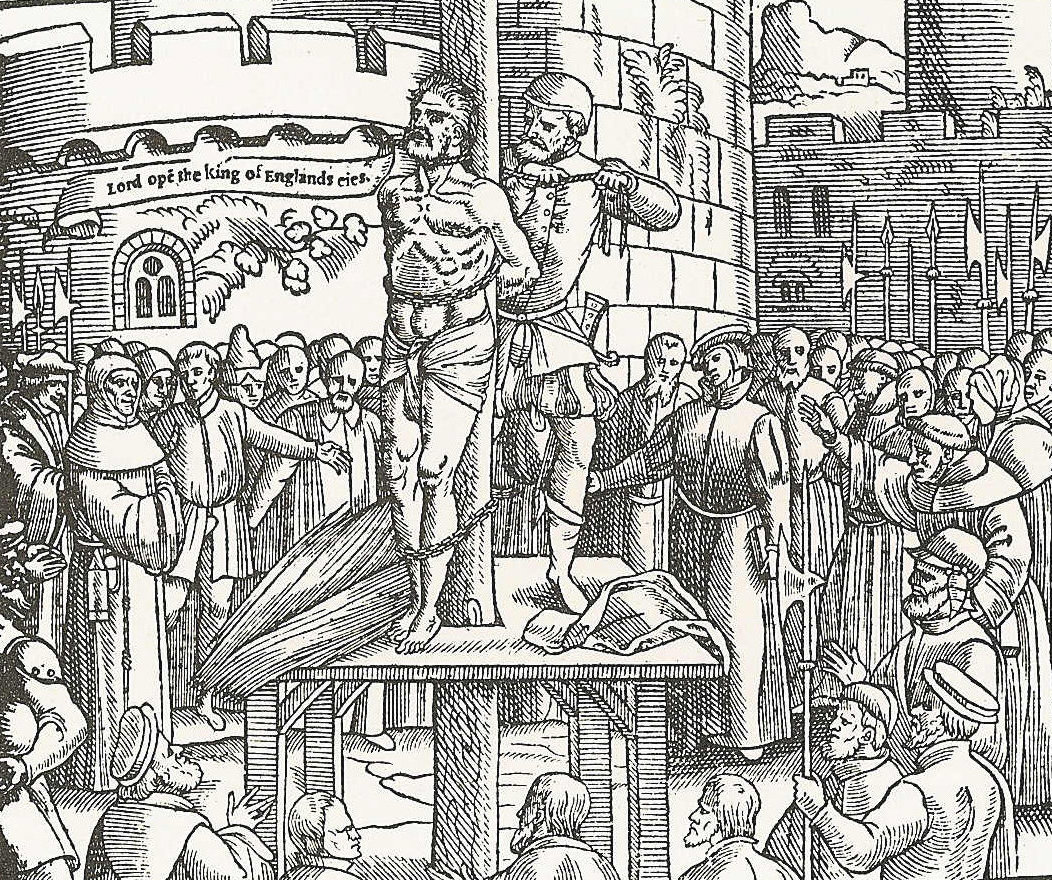
The God of Abraham, Isaac, and Jacob had a purpose with the nation of England, and with Tyndale’s efforts, England and its future colonies would never be the same.
Following Tyndale’s death, Miles Coverdale would print the first complete English Bible. The Thomas Matthews Bible followed in 1537, the first complete English Bible translated in full from the original texts, without using the Vatican manuscripts. In 1539, only three years after Tyndale’s death, the King of England would commission the first authorized translation of the Bible, known today as the Great Bible.
Tyndale’s prayer was answered.