The excitement and anticipation of a two-week trip to the Holy Land is a feeling that can only be experienced. Suitcases have been packed, accommodation arranged, and itinerary set. The ride to the airport elicits an eager anticipation of a transformative journey. Upon arrival at the airport, passengers are met with strict security protocols from the El Al team (Israel’s national airline).
The name El Al is taken from Hosea 11:7—“And my people are bent to backsliding from me; although they called them to (el) the most High (al); none at all would exalt him.” The airline’s name was chosen by its first Minister of Transport, David Remez, and is a reminder of Yahweh’s enduring love for Israel, even when the nation turns away from Him. It is a call for all people to look upward to seek the Holy One of Israel. We should never lose our confidence in the Almighty, who tells us:
“The Lord, the Lord God, merciful and gracious, longsuffering, and abundant in goodness and truth, keeping mercy for thousands, forgiving iniquity and transgression and sin, and that will by no means clear the guilty” (Exodus 34:6-7).
The gate for departure to Israel is different than any other flight
The eleven-and-a-half-hour flight departing Boston, direct to Tel Aviv, is leaving late Saturday night. The airline suspends flight operations on the Jewish day of rest, Shabbat. Waiting at the gate for departure to Israel is different than any other flight. You hear a mix of English and Hebrew conversations, you see people praying with tefillin (phylacteries), tzitzit (fringed garments), and a tallit (prayer shawl). There is a family atmosphere in the crowd, which is almost all Jewish, as very few tourists are travelling because of the war. As the departure time approaches and the gate becomes crowded, heavily armed security arrives with explosive-sniffing dogs. The rise of antisemitism has created a need for exceptional precautionary measures.
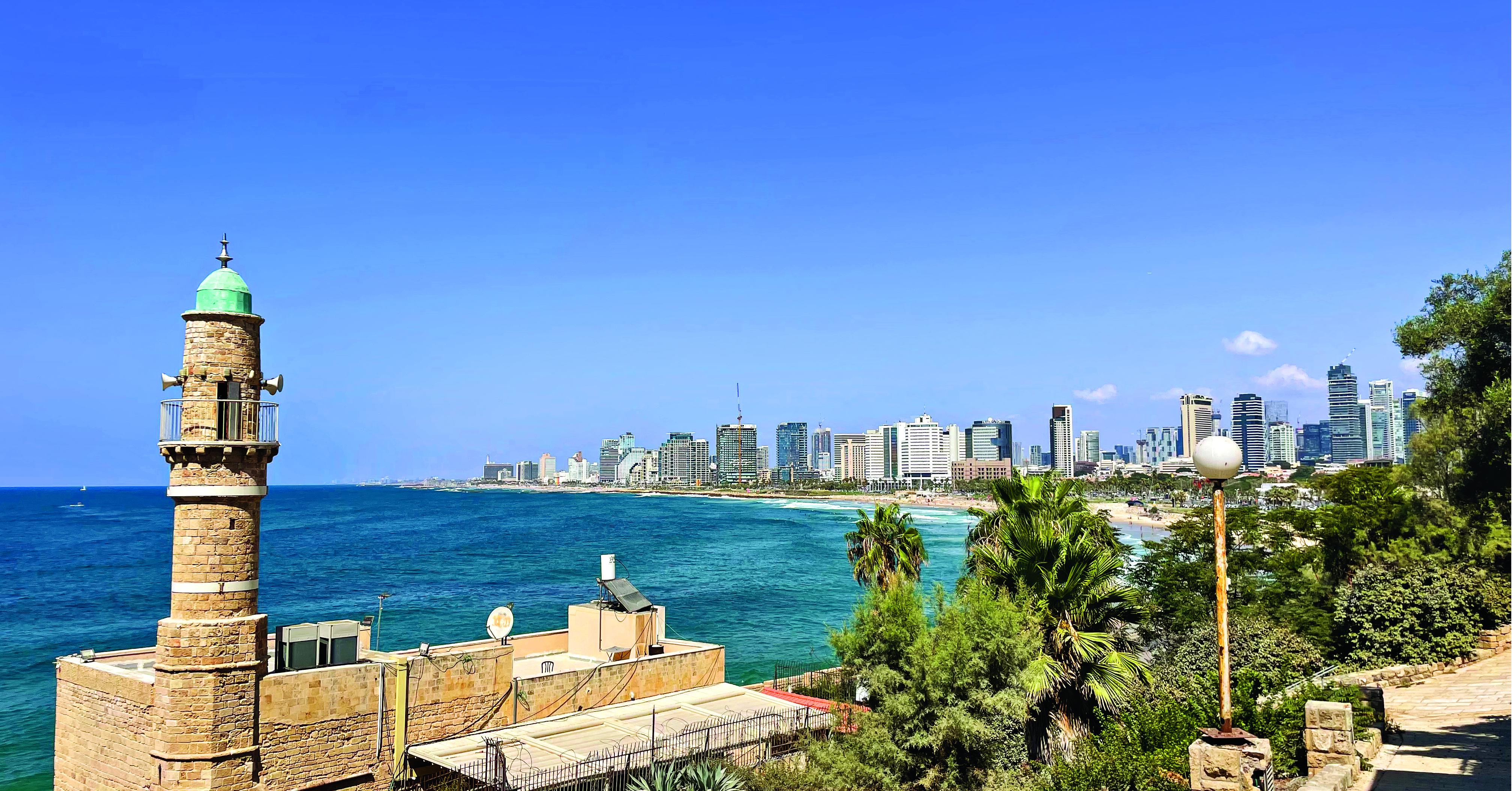
After dinner and a few hours’ sleep on the plane, the Mediterranean Sea meeting the Israeli coast comes into focus. Long swaths of rugged coastline, crystal-clear water, white-sand beaches, and large tracts of farmland all provide an image of a flourishing country. You fly over the tall skyscrapers of Tel Aviv, ranked among the top global tech hubs, and off in the distance are the mountains of Israel and the region of Judea and Samaria.
The words of the prophet Ezekiel in chapter 38 are easy to recall:
“I will go to them that are at rest, that dwell safely, all of them dwelling without walls, and having neither bars nor gates, to take a spoil, and to take a prey; to turn thine hand upon the desolate places that are now inhabited, and upon the people that are gathered out of the nations, which have gotten cattle and goods, that dwell in the midst of the land.”
Current events in the Land after the terrorist attack of October 7th, 2023, the war with Hezbollah and the destruction of Iran’s nuclear facilities, bring us closer to a nation dwelling safely.
The long walkway towards immigration is lined with photographs of the hostages still being held by Palestinian terror groups in Gaza, a stark reminder of the pain being felt by the nation. Yellow ribbons and yellow chairs are seen all over the country—at each roundabout and on the door handles of cars. Restaurants have set tables that are reserved for the safe return of the hostages.
After a few questions from an immigration agent and a quick peek at our passports, we were greeted with a wide smile and “welcome back.” Our rental car was ready upon arrival, and we headed toward the coast. Our first two nights are in Herzliya, a small surfing town with a quiet, peaceful vibe—the perfect place to adjust to the seven-hour time change.
After a full night’s sleep, we start our 16-mile journey on the winding boardwalk connecting Herzliya and Joppa. As we walk along the Mediterranean Sea, we feel the sun and wind and are energized to begin a wonderful adventure. After a few miles of walking, we rent electric scooters and make our way past beautiful beaches, families relaxing, and a bustling metropolitan city. We arrive in Joppa and make our way down the ancient streets, past art galleries and some of the world’s oldest ports, to an amazing Greek restaurant where we review our itinerary and plan for the next two weeks. Our first stop in Joppa was at the house of Simon the Tanner. This site reminded us of the wonderful vision and the message of Scripture, proclaiming that the Gospel of salvation is available for both Jews and Gentiles.
Our journey now takes us north to the Sea of Galilee. We travel along the coast, past the port city of Haifa, and to Mount Carmel. As you look down at the lush farmland in the valley below you, recall the prophet Elijah and the contest against the prophets of the pagan god Baal to determine who was the true God. As Elijah called out to Yahweh in 1 Kings 18,
“The Lord, he is the God; the Lord, he is the God.”
This is a message that we can carry in our hearts and lives each day as we serve the Creator of the universe.
The beauty of the Golan Heights comes into view along with the Sea of Galilee, glimmering under the setting sun
The beauty of the Golan Heights comes into view along with the Sea of Galilee, glimmering under the setting sun. The Galilee mountains, along with the sky, turn red and bright orange. We arrive at our accommodation at the perfect time. We stay in Ramot Galilee with a bright, cheery Jewish family with two young children. They welcome us into the upstairs apartment with a full view of the lake. They are pleased to meet us and have several ripe mangoes waiting for us in the kitchen. The family is so appreciative of the support during this time of uncertainty in the country. The place is a quiet farming Moshav in the Upper Galilee, both self-sufficient and welcoming. We walk along the side streets of the neighbourhood, with the playful laughter of children riding bikes, to a local restaurant.
The Upper Galilee is flourishing with activity—its mountainous landscapes, nature reserves, ancient ruins, and Biblical sites create a peaceful place to take in Yahweh’s beautiful creation and to hike the Holy Land. As you hike down Gamla Reserve to one of the oldest synagogues in the world, you find yourself standing where Jesus taught and declared in Matthew 5:14:
“Ye are the light of the world. A city set on a hill cannot be hid… Let your light so shine before men, that they may see your good works, and glorify your Father which is in heaven.”
What a wonderful reminder of our calling in Jesus Christ.
As you drive past Mount Hermon and make your way along the winding roads, you arrive at the Nahal Ayun Nature Reserve, a beautiful hike on the border of Lebanon with four gushing waterfalls. As you reach the top of the hike, you view the border fence with Lebanon, watching UN vehicles drive past on a small dirt road every few minutes. What is missing this time is the Lebanese flag and the army station where it previously hung. The Israeli army has pushed 3 miles past the border and dismantled the army outpost.
On our drive back to the Moshav, we are as far north as possible, driving along the Syrian border and the Israeli troops’ buffer zone. Without another car in sight, we make our way along the Golan Heights while taking in the open range and farmland. The drive down becomes steep and winding.
After an invigorating day of hiking and travel, we cool off with a swim in the Sea of Galilee. It becomes easy to imagine Jesus proclaiming the Kingdom of God, teaching the beatitudes, and performing miracles, such as healing the sick. As we take in the scenery and the calm of the water, we are reminded of the words of Matthew 5:
“Blessed are the merciful: for they shall obtain mercy... Blessed are the peacemakers: for they shall be called the children of God.”
Our time in Galilee has come to an end, and we travel along the Jordanian border, taking in the beauty of the landscape and the Mountains of Judea. The words of the Almighty to Abraham, in Genesis 12:7, come alive:
“The Lord appeared unto Abram, and said, Unto thy seed will I give this land.”
We make our way to Jerusalem, getting a glimpse of Jericho and passing the River Jordan, where Israel would have crossed into the Land, and Naaman washed himself and was healed of leprosy.
We drive upwards surrounded by the Judean Mountains, heading towards Mount Zion for a few nights’ stay in the city of the great King (Psalm 48:2). As we settle into our condo, we take in the view of the Temple Mount and the glowing desert off in the distance. The city is teeming with activity. Even without tourists, it is alive with young and old children running and playing. Large groups of youth here on Aliyah are singing in the Old City.
Our visit to Jerusalem is full of enthusiasm, positive emotions and liveliness. We speak with a shop owner who tells us that his business is better than ever, as “Jews are coming from all over, from the diaspora, to support the country during this time.”
We explore the ancient City of David, where we see the beginning of the establishment of Jerusalem as the unified capital of the Israelite Kingdom. As we walk through the water of Hezekiah’s tunnel, our flashlights leading the way, we are immersed in the history and Truth of the Bible’s message and see that nothing is impossible with Yahweh. Our time at the Western Wall is met with large crowds and Selichot prayers. Traditionally, these prayers focus on asking Yahweh for mercy and forgiveness, and now also include appeals for the well-being of the soldiers, healing of the sick, the swift return of the hostages, and for peace and security in Israel.
They are intrigued that we believe in the promises to Abraham, Isaac, and Jacob, and in the God of Israel, and not the Trinity.
We talk with many Jewish people along the way. They are intrigued that we believe in the promises to Abraham, Isaac, and Jacob, and in the God of Israel, and not the Trinity. They confirm their belief in the Messiah and that Yahweh has brought them back to the Land to fulfill his purpose with them and the entire world. They quote the words of Isaiah 56 to us:
“For mine house shall be called a house of prayer for all people.”
We had many thoughtful conversations with a people who are rethinking the prophecies, the legitimate criticism Jesus had of the people, and the blessings of being back in the Land of promise.
Sitting in the warm evening air, enjoying dinner under the stars, our waiter walks slowly over to our table. He leans in and quietly tells us not to be alarmed, but that we are likely to hear a bomb siren shortly. He lets us know where the shelter is as he walks away. A few minutes later, we hear a piercing whirl, and most patrons remain seated as we make our way to the bomb shelter. A few people join us, ask where we are from, tell us not to worry, and put us at ease. Most people didn’t care about the siren; they told us they had war fatigue and heard the sirens all the time.
We head towards the Dead Sea. It is hot and dry; the sea glistens with a visible steam above the surface. We are staying at an En Gedi Kibbutz, an oasis with over 900 plant species from around the world, and it is the only populated botanical garden on the planet. Our time in the desert is spent hiking where David hid from Saul. We swim in large pools of water and are revitalized as waterfalls gush over us. It is here that David refused to kill Saul and placed his trust in Yahweh’s judgment and timetable.
“Trust in the Lord with all your heart and lean not on your own understanding; in all your ways acknowledge him, and he shall direct your paths” (Proverbs 3:5).
Our time in Israel has been an epic adventure, a blessing and an encouragement that Yahweh is bringing about His plan and purpose with His nation of Israel. The words of Deuteronomy 11 could not be clearer: “a land which the Lord thy God careth for: the eyes of the Lord thy God are always upon it, from the beginning of the year even unto the end of the year.” Even so, come, Lord Jesus.